Led Samsung Notes and Messages for Galaxy XR. Defined the app model, spatial interaction patterns, layer hierarchy, and multitasking behaviors across Home Space and Full Space contexts.
Galaxy App Spatial System
A spatial operating framework for XR built on a dual-mode system — Home Space and Full Space — defining how apps coexist, scale, and transition across contexts.
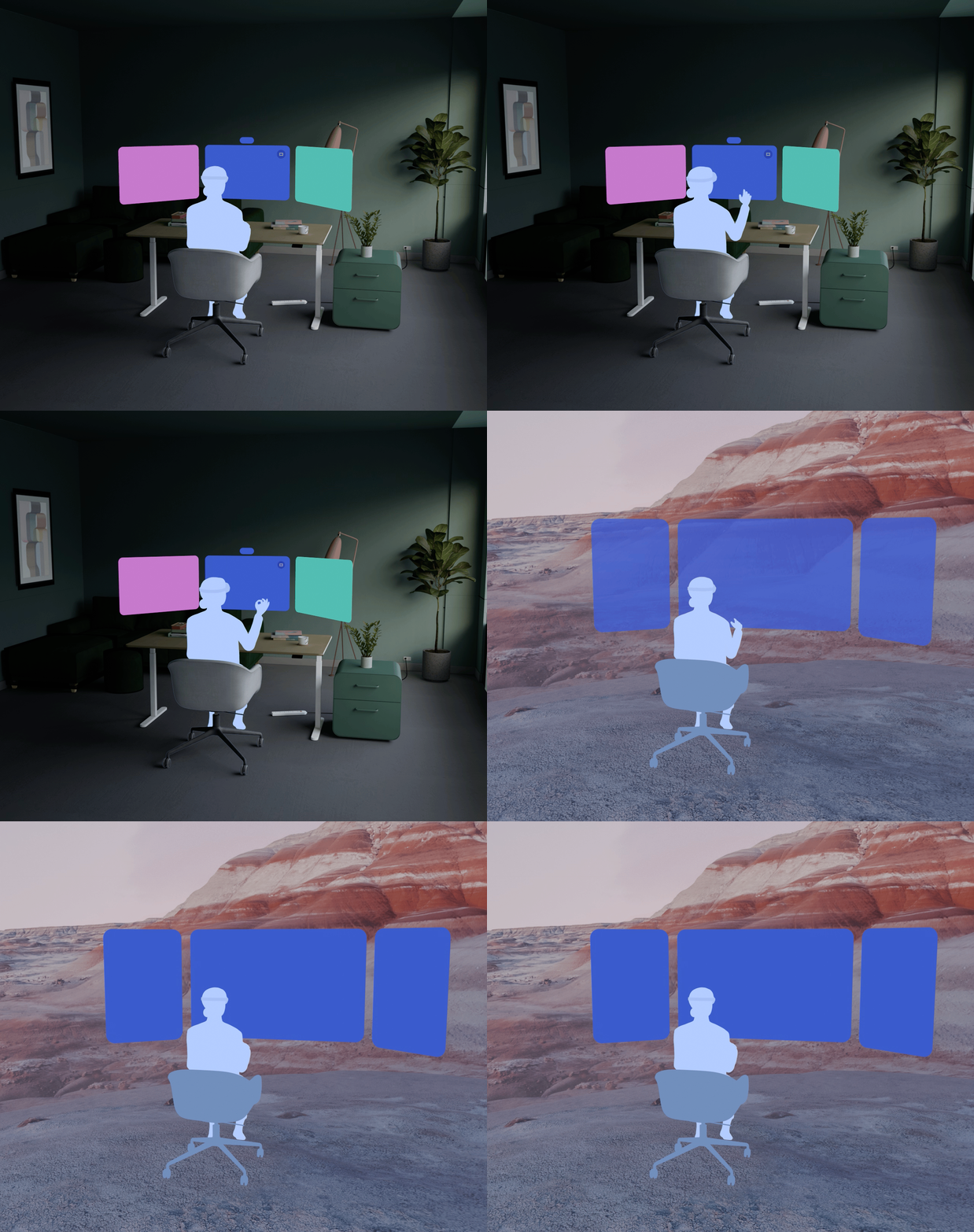
Galaxy XR required a coherent app system — not just individual apps, but shared rules governing how they coexist and transition. At its core is a binary between Home Space Mode (HSM) and Full Space Mode (FSM), defining how apps live, scale, and shift as user intent changes.
The system is defined through a dual-mode framework, spatial layering, persistent system surfaces, and a distance-based scaling model.
Cross departments, e.g., UX, Engineering, Research, Product Planning, etc.
Persistent interaction models ensuring continuity across app types and spatial contexts.
Two modes, one system. Every decision about where an app lives, how it scales, and how it yields to other apps flows from the HSM/FSM split.
Problem
Spatial computing collapses the gap between the operating system and the physical world. Apps are no longer windows on a screen, but floating panels in a shared space. Core system challenges:
- Apps need a consistent chrome — close, resize, minimize — regardless of category or spatial scale.
- The OS must distinguish between coexistent (HSM) and immersive (FSM) without requiring explicit user mode switching.
- System surfaces — app windows, taskbar, keyboard, notifications, etc. — require clear spatial layouts to avoid depth conflicts.
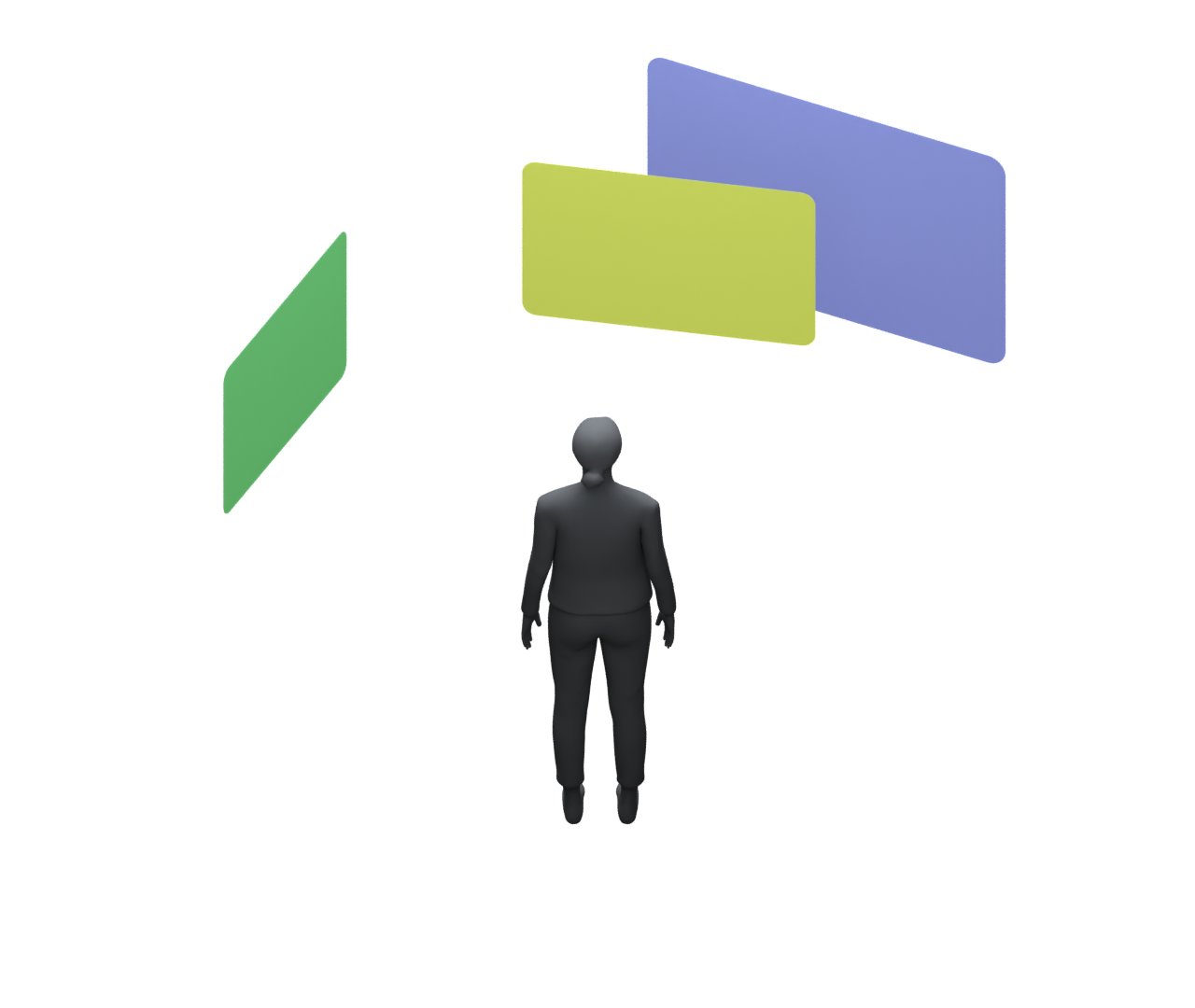
- Window size has no fixed physical meaning; The coordinate system must encode distance.
Approach
To address these challenges, the system defines a spatial operating model built on three core principles:
01
A dual-mode framework (HSM + FSM) to manage coexistence and immersion
Two modes, one system. Home Space Mode lets apps coexist in the physical world. Full Space Mode gives a single app total spatial authority. Every transition is system-managed — apps declare intent, the OS executes.
02
A layered spatial UI model to organize system and app surfaces
Five defined layers govern draw order, input ownership, and dismissal behavior across every system surface — from blocking modals down to app content. Same layer, same rules. No per-app negotiation required.
03
A distance-based scaling system (DMM) to ensure consistent ergonomics
1 dmm = 1 mm of physical width at any depth. Windows scale with distance, not screen resolution. Move a panel closer and it grows; push it away and it shrinks — the same physics as the physical world applied to software.
Together, these establish the rules for how apps live, interact, and transition across spatial contexts.
Impact and Outcomes
The system established a scalable operating foundation for Galaxy XR — enabling consistent behavior across apps, persistent spatial interaction, and system-managed transitions without per-app negotiation.
01
Unified spatial operating model
HSM/FSM, the spatial layer stack, and shared chrome established a consistent interaction model across all apps.
02
System-managed continuity
Transitions, persistence, and spatial memory became OS-level behaviors instead of app-specific logic.
03
Scalable ecosystem foundation
The same operating rules scaled across media, communication, productivity, and utility applications.
04
Ergonomic spatial interaction
Window placement, resizing, and recentering preserved readable, reachable, and spatially stable interaction.
05
Shared system behaviors
Notifications, voice interaction, keyboard invocation, and system surfaces behaved consistently across contexts.
Next Project