Urban Playground at Chicago Skydeck
The lower-level experience at Skydeck Chicago culminates with Urban Playground — a mixed-media projection piece displayed across a curved surface, leaving visitors with a lasting impression of what makes Chicago so extraordinary before they ascend to the Ledge.

Urban Playground — curved projection installation, lower level, Skydeck Chicago at Willis Tower.
Urban Playground sits at the threshold of the Skydeck experience — the last thing visitors see before the elevator takes them up 103 floors. Its job is to build anticipation: to compress what makes Chicago vivid and surprising into a single, immersive impression that primes visitors for the view they're about to encounter.
The piece is structured around a real 3D model of Willis Tower at its center, surrounded by an animated collage of Chicago highlights. My work covered storyboarding, style frame development, 3D composition, and UI — across two animated loop videos designed for a custom curved projection surface.
The visual system was organized into three registers: typographic text placement in 3D space, a Chicago iconography set, and an Art Scene — a mixed-media collage drawing on graffiti, pointillism, and oil painting styles.
Space & Layout
The curved projection surface wraps around the lower-level gallery, creating an enveloping environment rather than a flat screen. The Willis Tower 3D model anchors the center of the composition — a literal reference point connecting visitors to the building they are inside and the view they are about to reach.
Layout tests established the pixel map, projection geometry, and framing grid that governed how content would distribute across the curve — ensuring the composition held together at wide viewing angles and from multiple positions in the space.


Pixel map, space render, layout test, and framing grid — establishing the geometry of the curved projection surface before content development.


Curved surface mapping and camera studies for the projection environment.
3D Composition
Willis Tower sits at the center of the composition as a 3D model — its bundled-tube silhouette immediately recognizable to any visitor who just rode the elevator to get here. The surrounding content radiates outward from it, treating the tower as both anchor and subject.
The 3D composition work involved placing and staging the model within the projection environment, testing camera angles, depth treatments, and how the tower's form interacts with the graphic layers around it.


Willis Tower 3D model and spatial composition — the tower at the center of the experience, surrounded by Chicago content.
Storyboards
The storyboard phase mapped the full sequence of both loops — establishing the timing, transition logic, and content density for each section. With a curved projection surface and multiple content registers running simultaneously, the storyboard was the primary tool for controlling what draws attention, and when.




Storyboard sequence — timing, transitions, and content density for both animated loops.
Style Frames
Three visual registers were developed in parallel — each addressing a different dimension of the Chicago experience and a different graphic language within the same curved environment.
01 — Text Placement in 3D
Typographic content — facts, figures, neighborhood names, historical notes — was placed as objects within the 3D space rather than as flat overlays. Each text element occupies its own depth plane, creating a sense of spatial layering as the camera moves through the composition.


Text placement in 3D — seven style frames showing typographic content staged as spatial objects within the curved projection environment.
02 — Iconography Sets
A bespoke Chicago iconography set was developed to give the piece a recognizable visual shorthand — distilling landmarks, cultural symbols, and urban details into a consistent graphic language that could animate across the curved surface without competing with the 3D composition.


Chicago iconography set — landmarks, cultural symbols, and urban details as a consistent graphic language for the projection.
03 — Art Scene
The Art Scene is the most expressive register in the loop — a symphony of visual styles drawn from graffiti, pointillism, and oil painting, collaged together into a single moving composition. Chicago has one of the richest public art traditions in the US, and the Art Scene was designed to carry that energy: dense, plural, alive.


Art Scene — clay render and initial style test, mixing graffiti, pointillism, and oil painting styles into a single animated composition.
In-Space Mockups
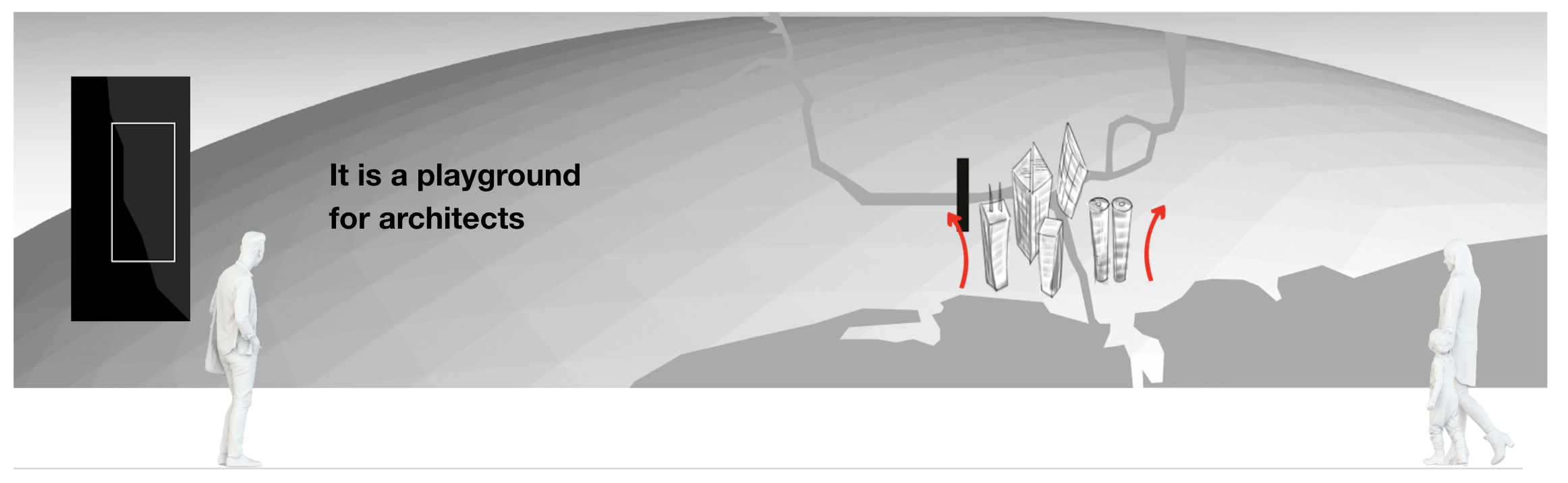
Final mockups placed the developed content back into the physical exhibition space — testing how the piece read from the visitor's perspective inside the lower-level gallery, with the curved projection surface and ambient lighting of the actual room.


In-space mockups and final installation photography — Urban Playground in the lower-level gallery at Skydeck Chicago.
Outcome
Urban Playground opened as part of the permanent Skydeck Chicago experience in 2021. As the final experience before the elevator ascent, it functions as both a visual climax of the lower level and an emotional primer for the Ledge — distilling everything vibrant about Chicago into a single, immersive impression that visitors carry upward with them.
Next project